



Does US Car Manufacturing Industry Scale or Decrease in 2025 - 2026
Does US Car Manufacturing Industry Scale or Decrease in 2025 - 2026
There is a noticeable dichotomous statistic that showcases a split between domestic manufacturing and consumer sales. While the manufacturing aspect for US car manufacturers is stabilizing from a decline in 2025, the decrease in consumer sales to 15.8 million units sold domestically showcases somewhat of a shift towards important vehicles. The main driving factor behind these changes is the emergence of bigger manufacturing players in the face of China. The manufacturing giant is responsible for more than 85% of total global EVs produced, and as consumer intent and interest shift more and more towards alternative energy sources, more and more people look towards imported vehicles, rather than American-made ones.
What are the latest Car Export Trends in 2025 - 2026
The trend for car exports in 2025-2026 for the U.S. is heavily shaped by a change in the supply chain and a realignment, as well as a change in the trade environment. There is a noticeable volatility in finished car exports at the end of 2025, peaking at 181,000. The overarching trend seems to be that there is a major pivot towards hybrid vehicles over fully electric ones. The primary trade corridors for the U.S. are Canada, Germany, Mexico, and China, which remain the major challenges for finished American car exports. Canada alone received more than $1.26 billion worth of finished American vehicles in the past few months.
The Big Picture - How Much the US Is Exporting Now
The current trend for the 2025 to 2026 period is that the United States is exporting approximately 800,000 to 1 million American-made vehicles annually, which generates over $54 billion in export value. The key fact here is that the U.S. is running a 3-to-1 trade deficit, which sees it import 3 times more vehicles than it exports, which is valued at $181 billion that it sends overseas. In total, the U.S. ships to over 100 markets globally, though the major ones remain in North America. Canada receives $12.7 billion worth of vehicles, Germany nearly $7.82 billion, and Mexico valued at 3.96 billion.
What Counts as a US Car Export - New, Used, and Containerized Vehicles
The legislative language for US car exports is very clear, stating that any self-propelled vehicle that is transported out of the US into a foreign commerce environment, and is valued over $2,500, is considered to be an exported vehicle. To be clear, exporters need to file an Electronic Export Information document via the US’s Automated Export System.
There is a distinct classification difference between new cars and used cars exports. Where new cars must have a standard Certificate of Title from a Manufacturer. The vehicle must come directly from a manufacturer, a distributor, or a dealer. These vehicles are exported using an original MSO and a dealer’s invoice.
Used car exports are defined as any vehicle that has a legal title that has been transferred from a manufacturer or a dealer to a final customer. A vehicle can be 0 miles on its odometer, but if it has been purchased by an end retailer, it is considered a used vehicle. This means that anyone has to be exporting vehicles from the USA.

Which Countries Buy the Most American Cars
Statistics from 2025 and 2026 show that, historically, Canada and Mexico are by far the U.S.'s biggest car export targets. This is mainly due to the integrated cross-border supply chain of the North American market. It makes sense that its closest neighbours would be its biggest target.
The top global buyers and those who are exporting cars from the USA are China, Germany, the UAE and Australia. This is a healthy diversification of trade, and while Canada & Mexico are the U.S.'s most faithful and reliable trade partners, a diversification gives the U.S. far more stability in terms of options.

The Fastest-Growing US Car Export Markets in 2025
We’ve talked about the current biggest markets, but you will definitely be surprised by the fastest-growing US car export markets, those being Nigeria, Georgia and Lithuania. These seemingly outlying export targets can be considered momentary and transitional markets that emerged during a major shift in global trade and a shift from traditional vehicles to hybrid and electric alternatives. Global tariff shifts have also affected that statistic, which does not take away the fact that, while emerging, these markets are low-volume, compared to the long-standing participants who love exporting vehicles from the USA.

There has been a major market shift in 2025 in the U.S., driven by waning consumer purchasing power, skyrocketing new-car prices, and a high auto loan delinquency rate. Furthermore, the EV sector has also seen a big drop from 10.5% to 5.8% of total new car sales since the tax credit program ended.
Both traditional gas-powered cars and fully electric ones lost significant overall market shares in 2025, as consumers mainly focused on buying hybrid vehicles. The biggest losses due to this shift are reported by Stellantis, Volkswagen, and Tesla, while manufacturers like General Motors and Toyota expanded their dominance due to a significant availability of hybrid selections.
Why US Car Exports Are Rising Overall
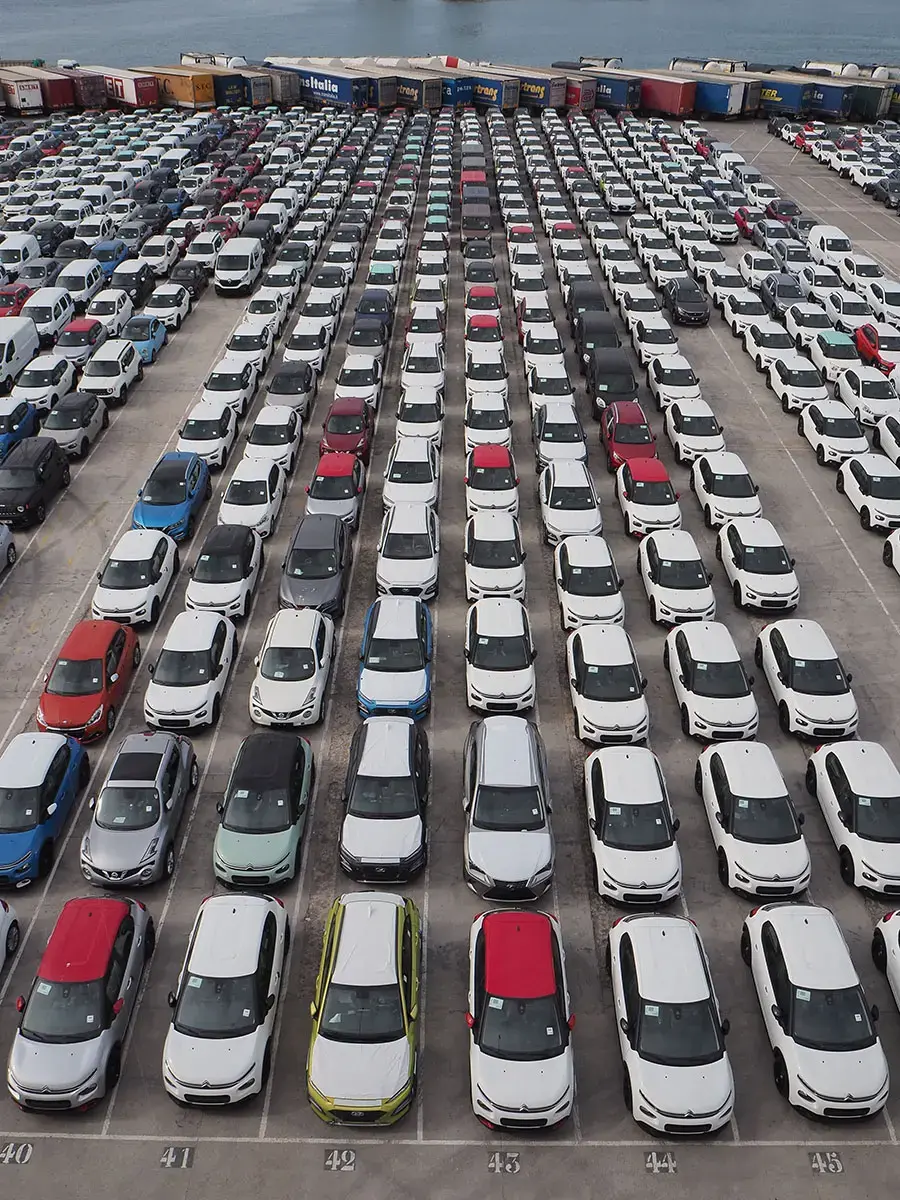
Despite the 2025 dip, the US car export market has been steadily regaining its power and has even reported a steady rise. This can be attributed to the increased foreign demand for American-made luxury cars, the many different competitive North American manufacturing investments, and the fact that global automakers use the U.S. as a natural base for manufacturing as a way to bypass international trade tariffs.
Why Some Countries Are Importing More from the US
Why Some Countries Are Importing Less from the US
What American Car Brands and Models are Popular Globally in 2025 -2026?
What are the US Car Exports Shares Globally?

The U.S. places 6th in the global automotive exports, at least by value, which is 7% of the total global automotive export market. The U.S. is trailing behind leaders like China, South Korea, Germany, and Japan, which have far larger holds on the total market.
Canada- The Largest and Most Stable Destination
Canada is historically the largest and most stable country that is exporting cars from USA, not only in terms of vehicles, but also in many other goods. From 2025 to 2026, Canadians have purchased $23 billion worth of American-made cars. This drastically outpaces the US export rate for other trade partners such as Germany, Mexico and China.
Mexico - Cross-Border Auto Trade and Manufacturing Links
Speaking of Mexico, it is the US’s second-largest new car export target, with a lot of focus on secondary markets for spare parts and used cars. Mexico is also a very big manufacturing hub for parts for American-made cars, primarily due to lower labour costs and a high level of skilled labour that would otherwise be much more expensive to employ in the U.S. The Mexican auto industry is deeply intertwined with the US and Canada, due to its highly integrated cross-border supply chain, where parts for cars pass the borders multiple times before the final finished product is produced.
Europe, Germany- Why Europe Still Matters for US Vehicle Exports
Europe, and for the most part Germany, is both a big competitor and a great target for American exports, in particular cars. As explored above, the need for high-end luxury cars in Europe is great, and while German manufacturers like BMW, Mercedes, Audi and Porsche do fill in this niche, the American-style cars are also in demand.
For the most part, U.S.-made vehicles are coming in the form of second-hand, used vehicles with a salvage title, meaning the car has been in an accident, it has been restored and is being sold to a secondary market outside of the U.S., either by dealership or by means of online car auctions.
China - Tariffs, Competition, and a Changing Demand Mix
2025 marked a big turning point for the U.S. and China relations, with some tensions between the two countries manifesting in the form of export and import tariffs. The newly elected Trump administration sought to protect American manufacturers by implementing heavy tariffs on imported vehicles, in particular from China. In response, China enacted quite severe temporary tariffs on the U.S., causing a sudden dip in imported goods, and in particular EV’s.
As a result, South Asia has taken over the U.S. as China’s top car export destination. Despite the tariffs on imports, China has also secured robust ties with more than 53 African nations in order to secure raw materials, while also providing favourable export practices across the entire continent.
United Arab Emirates - Luxury Demand and Regional Re-Export Power
The UAE is a serious contender for one of the biggest import destinations of luxury vehicles, on one hand, due to the abundance of cheap gasoline and diesel, and on the other, due to a higher GDP and per capita income that can more than handle the high price of American-made luxury vehicles. They are both a status symbol and an opportunity for local car buyers to diversify local markets, which are mostly dominated by Chinese and European manufacturers.
South Korea - Why SUVs and EVs Matter There
South Korea is an interesting case in particular, because its main import target for the period of 2025 and 2026 has been large SUVs and EVs manufactured in the U.S. There are many reasons why that may be, for example, they can be seen as a status symbol, as South Korean culture has adopted a western approach, in particular in clothing, music, marketing and general lyfestuyle choices.
Saudi Arabia - Premium Vehicle Demand in the Gulf
Saudi Arabia is one of the most reliable and intentionally fixated Gulf countries that prefer the Premium options the US has to offer. Just like with the UAE, Saudi Arabia also sees the ownership of American luxury cars and brands as a status symbol, which showcases a diversity in taste and an abundance of wealth. As one of the major petrol and crude oil exporters in the world, Saudi Arabia's gas prices remain low and steady, despite global supply chain disruptions in fuel, meaning that it is still a very valid target for American exports of more fuel-inefficient vehicles.