
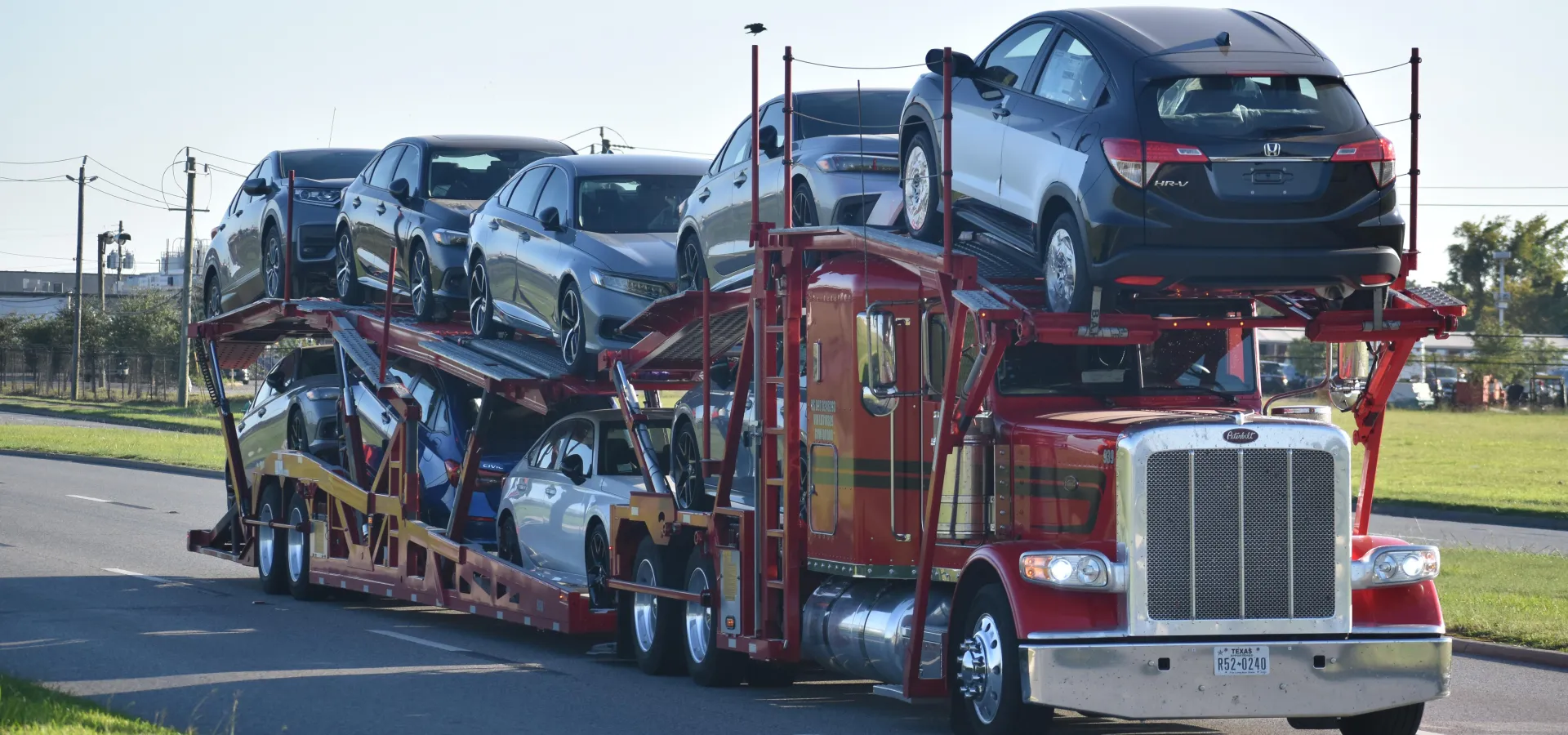
Shipping a car from California to Texas costs $950 to $1,550 on an open carrier. City pairs run 1,270 to 1,920 miles. A carrier is assigned within 1 to 3 days, then the drive takes 2 to 4 days.
Key facts
California to Texas, open carrier - $950 to $1,550
California to Texas, open carrier - $950 to $1,550
Enclosed - +34.1% on 1,000 to 1,499-mile pairs and +38.9% on 1,500 to 1,999-mile pairs
Distance - 1,270 to 1,920 miles, depending on the city pair
Cost per mile - $0.54 to $1.20 on an open carrier, depending on the city pair
Dispatch 1 to 3 business days, transit 2 to 4 days, 3 to 7 days in total
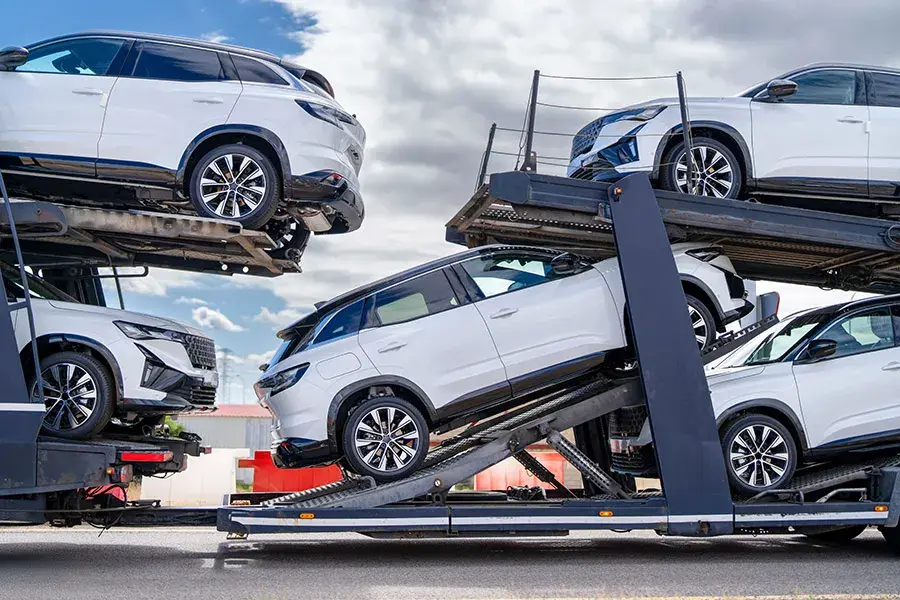
Corridors - I-10 through Phoenix and Tucson, or I-40 and US-287 through Flagstaff and Amarillo
Cheapest window - late summer through fall; most expensive - spring through midsummer
Direction - eastbound costs $150 to $225 more than Texas to California
Texas registration - 30 days, at the county tax assessor-collector
Texas safety inspection - none since 1 January 2025; emissions still required in 18 counties
Payment - nothing collected until a verified carrier is assigned
Prices shown - estimates; final price moves with the market
How much does it cost to ship a car from California to Texas?
Shipping a car from California to Texas costs $950 to $1,550 on an open carrier, based on 6 months of SGT Auto Transport bookings, and enclosed adds 34.1% to 38.9% depending on distance.
City pairs range from $0.54 to $1.20 per mile, because the shortest runs carry the highest per-mile rate.
Where your price lands
Enclosed adds 34.1% on pairs of 1,000 to 1,499 miles and 38.9% on pairs of 1,500 to 1,999 miles. The premium follows distance, not vehicle type.
Season, origin and flexibility decide where you land in the range. A sedan leaving Los Angeles in September with a wide pickup window sits near the floor. A pickup leaving San Jose in June on a fixed date sits near the ceiling. A figure well below the floor is not a bargain, because a load priced under what carriers accept sits unassigned while your date approaches.
Cost by city pair
Distance matters less here than most people expect. San Diego to San Antonio is the shortest run in the table at 1,270 miles and prices above San Francisco to Houston at 1,920 miles.
What moves the number is how heavily carriers run each corridor. Austin, Dallas, and Houston pull constant freight from both Southern California and the Bay Area, so competition holds those lanes down. A destination off the main flow prices higher even when it is closer.
Delivery time does follow distance. Pairs under about 1,500 miles, mostly from Southern California, take 2 to 3 days, while longer Bay Area runs and Houston-area deliveries take 3 to 4.
| Origin | Destination | Price range | Distance (mi) | Transit time |
|---|---|---|---|---|
| Los Angeles, California | Austin, Texas | $1,000 - $1,350 | 1,380 mi | 2-3 days |
| Los Angeles, California | Houston, Texas | $1,150 - $1,375 | 1,560 mi | 3-4 days |
| San Jose, California | Austin, Texas | $1,200 - $1,375 | 1,720 mi | 3-4 days |
| San Diego, California | San Antonio, Texas | $1,100 - $1,525 | 1,270 mi | 2-3 days |
| Los Angeles, California | Dallas, Texas | $1,025 - $1,425 | 1,450 mi | 2-3 days |
| Fremont, California | Austin, Texas | $1,025 - $1,325 | 1,740 mi | 3-4 days |
| San Diego, California | Austin, Texas | $1,175 - $1,350 | 1,290 mi | 2-3 days |
| San Francisco, California | Austin, Texas | $950 - $1,550 | 1,760 mi | 3-4 days |
| San Francisco, California | Houston, Texas | $1,050 - $1,450 | 1,920 mi | 3-4 days |
| Alhambra, California | Dickinson, Texas | $1,100 - $1,300 | 1,570 mi | 3-4 days |
| Santa Clara, California | Austin, Texas | $1,225 - $1,450 | 1,720 mi | 3-4 days |
| San Diego, California | Houston, Texas | $1,100 - $1,325 | 1,480 mi | 2-3 days |
| San Jose, California | Fort Worth, Texas | $1,175 - $1,500 | 1,660 mi | 3-4 days |
| Inglewood, California | Austin, Texas | $950 - $1,450 | 1,390 mi | 2-3 days |
| Los Angeles, California | McKinney, Texas | $1,100 - $1,200 | 1,470 mi | 2-3 days |
Data sourced from SGT Auto Transport's last 6 months of shipping for this route. All prices are estimates and may differ from the current market rates you may experience.
Cost by vehicle type
A carrier will focus on the available deck space, the amount your vehicle takes, and the weight allocated for that particular route. This is the basis for charging different prices for different cars. NOTE: Modifications like a lift kit, oversized tires, or a roof box change the height the carrier plans around, and an undeclared one may mean changing plans on the fly, which costs extra.
| Vehicle type | Price range |
|---|---|
| Sedan Compact | $1,000 - $1,425 |
| SUV Midsize | $1,025 - $1,475 |
| SUV Compact | $1,050 - $1,450 |
| Sedan Midsize | $1,000 - $1,450 |
| SUV Full-size | $1,025 - $1,500 |
| Coupé | $1,000 - $1,450 |
| Hatchback | $1,025 - $1,450 |
| Sedan Full-size | $975 - $1,400 |
| Pickup Crew Cab | $1,200 - $1,550 |
| Convertible | $1,000 - $1,375 |
| Pickup Small | $1,125 - $1,525 |
| Pickup Extended Cab | $1,075 - $1,550 |
| Station Wagon | $975 - $1,500 |
| Minivan | $1,125 - $1,550 |
| Passenger Van (8-12 People) | $1,325 - $1,550 |
| Cargo Van Large | $1,225 - $1,550 |
| Micro-Car | $1,100 - $1,225 |
Data sourced from SGT Auto Transport's last 6 months of shipping for this route. All prices are estimates and may differ from the current market rates you may experience.
For a figure against your own ZIP codes and dates, use the car shipping cost calculator.

Car Shipping Quote
- Get your quote fast and simple
- Instant car shipping cost calculator
- High accuracy in price estimation
- Ship a Car to Another State Easy
What affects your California to Texas shipping price
Eight things move a quote on this lane, and the first three account for most of the spread.
- The exact city pair. Carrier density on the corridor matters more than raw distance, so a longer Bay Area run can price below a shorter Southern California one.
- Vehicle size and weight. A pickup takes deck space a sedan would have filled.
- Open or enclosed. Enclosed adds 34.1% to 38.9% at this distance.
- Season and demand. Spring through midsummer is the firmest window.
- Diesel prices. A carrier's highest variable cost, and it starts reflecting in quotes within weeks.
- Access at both ends. A hillside Los Angeles street or a gated Plano community needs a meeting point.
- Running or inoperable. A non-runner needs a winch and an equipped carrier.
- Fixed or flexible dates. Guaranteed Pickup fixes a 24-hour collection window at a premium.
Best time to ship a car from California to Texas
Late summer through fall is the cheapest window on this lane, and spring through midsummer is the most expensive.
The pattern follows relocation habits, not weather. Households move at the end of the school year and corporate transfers cluster in the same months, so carriers leaving California fill first. Once that demand eases in August, rates soften into the autumn.
Holidays produce a short spike at both ends of the year.
Winter can slow the I-40 option through Flagstaff, where snow closes the pass several times a season. A Bay Area or Sacramento collection in January is the one case on this lane where weather is worth planning around, because those origins feed the northern corridor rather than I-10.
Book 7 to 14 days ahead as standard, and 2 to 3 weeks in peak season.
A wider first available date saves more than booking early, because it lets us match your car to a truck already running the corridor.
Twelve-month demand index from SGT booking data
| Month | Demand index | |
|---|---|---|
| January | 96 | Quiet |
| February | 89 | Quiet |
| March | $109 | Busy |
| April | $116 | Peak |
| May | 120 | Peak |
| June | 111 | Busy |
| July | 124 | Peak |
| August | 111 | Busy |
| September | 71 | Quietest |
| October | 76 | Quiet |
| November | 95 | Quiet |
| December | 83 | Quiet |
How long does it take to ship a car from California to Texas?
It takes 1-3 days to get a carrier, 2-4 days to travel; the total figure is 3 to 7 days from booking to delivery.
| Stage | Time |
|---|---|
| Carrier dispatch | 1 to 3 days from your first available date |
| Transit | 2 to 4 days on the road |
| Total | 3 to 7 days from booking to delivery |
Data sourced from SGT Auto Transport's last 6 months of shipping for this route.
When reading a quote, be sure to ask any company what delivery number they are giving you - anything beneath the 4-7 total delivery range may be suspicious.
What slows your California to Texas car shipment down:
- A multi-stop load with collections and deliveries scheduled before yours
- Desert heat advisories across the Mojave and Chihuahuan stretches in high summer
- Winter weather on I-40 near Flagstaff, which sits above 6,900 feet
- Peak season at either end, when every truck on the lane runs a full route
- A rural or gated address that needs a meeting point arranged
The California to Texas route
Almost every load on this lane takes one of two corridors, and which one depends on where the car starts.
I-10, the southern route. Los Angeles and the Inland Empire through Palm Springs, Phoenix and Tucson, into El Paso, then on to San Antonio or Houston. This is the shorter option and the one that stays open through winter.
I-40 and US-287, the northern route. Bay Area and Sacramento origins run south through Bakersfield and Barstow, then east on I-40 across Flagstaff and Albuquerque to Amarillo, where US-287 runs southeast into the Dallas-Fort Worth metroplex. It is the longer of the two and the one exposed to winter weather.
Migration from California to Texas keeps eastbound decks full, while westbound loads are harder to find.
That also explains the directional gap. California to Texas runs $150 more at the floor and $225 more at the ceiling than the reverse, because the eastbound direction is the loaded one and carriers price the scarce leg higher.
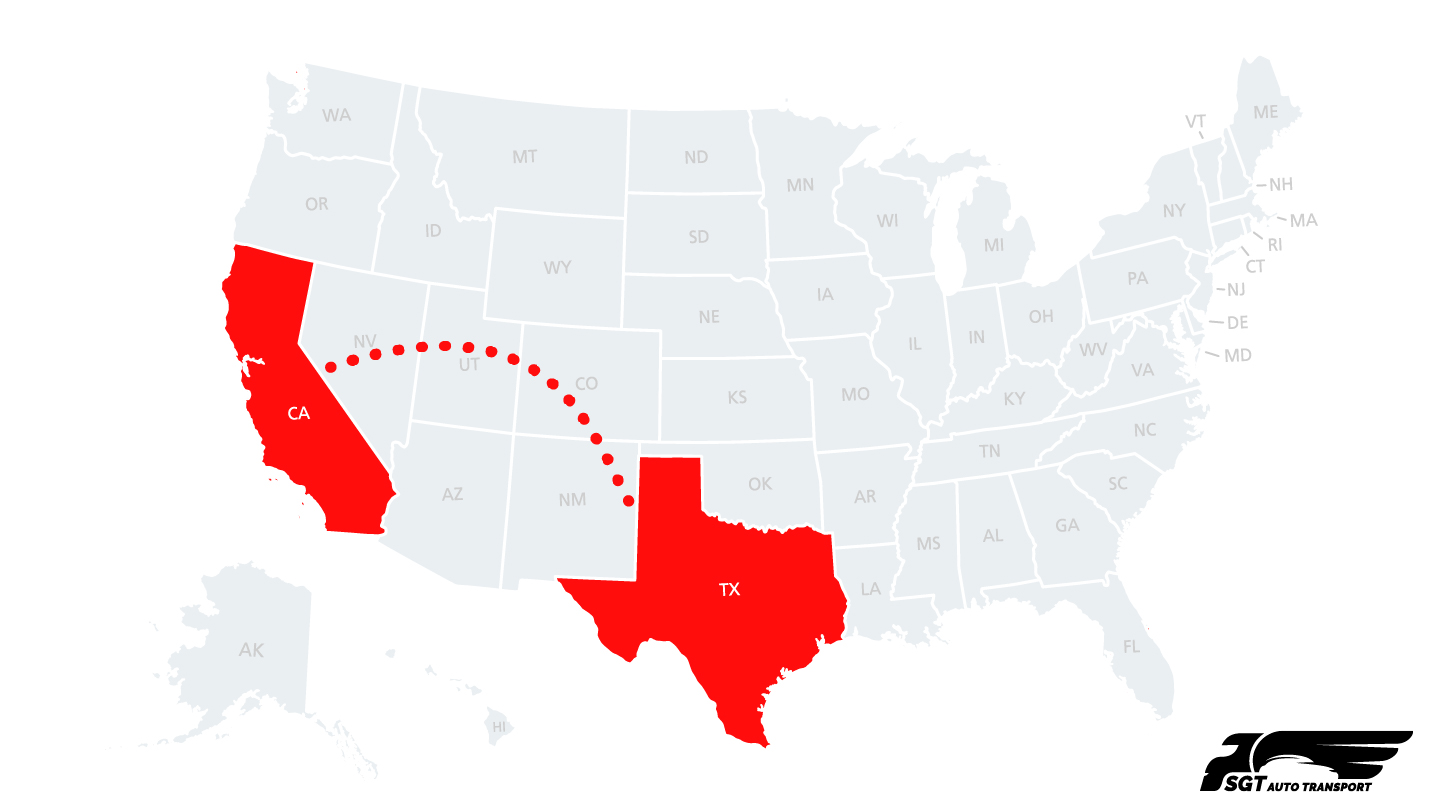
Types of Vehicle Transportation Services we provide in California to Texas
Make your choice for car shipping

Open car transport is a practical and budget-friendly choice for vehicle shipping. With fast transit times, flexible scheduling, and trusted service, it's no surprise that it's the preferred option for many of our customers.
Our cross-country car transport service offers a simple and convenient way to relocate your vehicle. From short interstate moves to coast-to-coast deliveries, we ensure your car reaches its destination safely and efficiently.
Choose our enclosed auto transport service when your vehicle deserves the highest level of protection. Enclosed trailers shield your car from weather, road debris, dust, and dirt, ensuring it arrives in pristine condition.
Whether you're relocating, buying, or selling a motorcycle, our reliable shipping service makes the process simple. We offer convenient door-to-door transport to ensure your bike arrives safely at its destination.
Need your vehicle picked up on a specific date? Our guaranteed car transport service is designed for customers with strict timelines, ensuring your vehicle is collected as scheduled and delivered with care.
Our college student car transport service makes it easy to bring your vehicle to campus. We pick up your car from your home and deliver it directly to your college, giving you the freedom and convenience of having your own transportation while you study.
Need to ship your vehicle on short notice? Our expedited car shipping service is designed for urgent situations, with vehicle pick-up available in as little as 1-2 business days, helping you stay on schedule.
Military relocations often happen with little notice, making dependable vehicle transport essential. Our military auto transport service supports active and retired military members by providing fast, secure shipping for PCS moves and other assignments.
How shipping a car from California to Texas works
Five steps from quote to delivery, with nothing collected until a carrier is assigned.
Get a quote.
Book and choose your pickup window.
Carrier assignment.
Pickup.
Tracking and delivery.
Car Shipping Quote
- Get your quote fast and simple
- Instant car shipping cost calculator
- High accuracy in price estimation
- Ship a Car to Another State Easy
Pickup in California, delivery in Texas
Where we pick up in California
Los Angeles, San Diego, San Francisco, San Jose, Sacramento, Fresno, Bakersfield, Long Beach, Oakland, Anaheim and Riverside, plus the wider Inland Empire and Bay Area.
Where we deliver in Texas
Houston, Dallas, Austin, San Antonio, Fort Worth, El Paso, Arlington, Plano, Corpus Christi, Laredo and Lubbock.

Access tips
The California end is the harder one. Hillside and narrow streets in Los Angeles and San Francisco cannot take a 75-foot carrier; gated communities need a gate code arranged in advance, and apartment complexes rarely have a turning circle.
Dealership, auction and port collections need the lot number, gate pass and release paperwork ready before the driver arrives.
Texas is easier. Suburban Dallas, Houston, Austin and San Antonio addresses usually take a full-size truck at the door, with gated communities the main exception.
If your address cannot take a carrier at either end, we agree a meeting point when you book rather than leaving it to the driver on the day. It costs nothing extra and it is still door-to-door service.
How to prepare your car
Leave the fuel at a quarter tank or less, or charge an EV to 30% to 50%
Remove personal items and both toll tags, FasTrak and any TxTag
Wash the car and photograph every side in daylight, including existing marks
Check for leaks, set tire pressure and test the battery
Disable the alarm, fold the mirrors and remove loose accessories
Hand over one key and keep your spare
Limit personal items to 100 lbs in one box in the trunk, since cargo insurance does not cover them
Flag any vehicle under four inches of ground clearance at quote stage, so a trailer with a lift gate is assigned
Ship or drive from California to Texas?
Shipping usually wins on this lane. Under about 700 miles, the drive is a single day with no flight home to pay for. California to Texas is 1,270 to 1,920 miles, which changes the answer.
Driving means 20 to 24 hours at the wheel across two to three days away from work, roughly $150 in fuel, one or two hotel nights and meals, then a flight home if the car is not travelling with you.
What settles it is the cost that never appears on a receipt. At the 2026 IRS business rate of $0.725 per mile, or $0.76 from July 1, Los Angeles to Houston costs roughly $1,130 to $1,185 to drive, fuel included, which on its own matches the cost of the shipment.
Driving still makes sense if you are moving with pets, towing a trailer, or the vehicle is old enough that the mileage does not matter.
Why SGT for California to Texas
MC 873392 and USDOT 2521690 are verifiable at FMCSA SAFER, where the authority reads active and the $75,000 BMC-84 broker bond appears in the same record.
Exact pickup dates. Guaranteed Pickup fixes a 24-hour collection window rather than a best-effort range.
No deposit. Payment is collected only once a named, verified carrier has accepted your vehicle at the quoted rate.
Cargo insurance in every quote. $100,000 to $150,000 open and $250,000 to $3,000,000 enclosed, with the $1,000 to $5,000 deductible paid by the carrier rather than by you.
Live tracking, a price match, and 128,940+ customers shipped.
Every carrier is vetted before assignment, not after a problem: active operating authority, current cargo insurance, a safety rating that clears our threshold and a review history with no repeating pattern of failure.





FAQs: shipping a car from California to Texas
$950 to $1,550 on an open carrier, and enclosed adds 34.1% to 38.9% depending on distance. The city pair moves it most, though carrier density matters more than raw distance.
$1,150 to $1,375 on an open carrier, covering 1,560 miles in 3 to 4 days on the road, after a dispatch window of 1 to 3 days. It is one of the two busiest pairs on this lane, alongside Los Angeles to Austin.
$1,025 to $1,425 on an open carrier, over 1,450 miles in 2 to 3 days. Dallas sits about 110 miles closer to Los Angeles than Houston does, which shows in the transit time more than in the price.
Three to seven days in total: 1 to 3 days to assign a carrier, then 2 to 4 days on the road. Southern California pairs under about 1,500 miles take 2 to 3 days on the road, and peak season widens the dispatch half rather than the drive.
Open transport, booked one to two weeks ahead in late summer or autumn, with a flexible pickup window and an accessible collection point. Those four choices together are worth more than any negotiation, and none of them costs you anything.
Yes, provided it rolls, brakes and steers. The carrier needs a winch and sometimes a lift gate, which adds 15% to the price. Declare it at booking rather than at collection, or the truck leaves without it.
Nothing beyond the bill of lading for the transport itself. For registration once it arrives, you need the California title, proof of Texas insurance meeting the 30/60/25 minimum, and the vehicle present at your county tax assessor-collector office.
Yes. Every carrier we assign holds cargo insurance verified before dispatch: $100,000 to $150,000 per load on open carriers and $250,000 to $3,000,000 per load on enclosed. The $1,000 to $5,000 deductible is the carrier's to pay, not yours. Ask for the certificate once your carrier is assigned. The limit covers all the vehicles on the load together, not each car, so in a total loss that exceeds it, you may have to cover the remaining amount.
Yes. It has to be someone over 18 does, and it does not have to be you. Name an authorized agent when you book. They inspect the car with the driver and sign the bill of lading at both ends, which is the document any later claim rests on.
Up to 100 lbs in one box or suitcase in the trunk, with front seats empty and nothing above the window line. Cargo insurance does not cover personal items, so anything lost is not recoverable, and weight above the allowance can be refused at collection.
Shipping the other way costs less. Texas to California runs $800 to $1,325 over the same distance, $150 below this direction at the floor and $225 at the ceiling, because westbound decks are the ones carriers struggle to fill.
| California to Arizona | California to Florida | California to Georgia | Florida to Texas | Illinois to Texas |
| California car shipping | Texas car shipping |
External sources
- Texas Department of Motor Vehicles. “Checklist for New Texans”. https://prod-origin.txdmv.gov/sites/default/files/body-files/ChecklistForNewTexans.pdf
- Texas Department of Motor Vehicles. “New to Texas”. https://www.txdmv.gov/motorists/new-to-texas
- Texas Department of Public Safety. “Vehicle Safety Inspection Program Changes Now in Effect”. https://www.dps.texas.gov/news/vehicle-safety-inspection-program-changes-now-effect
- Texas Department of Public Safety. “Bexar County Emission Inspections”. https://www.dps.texas.gov/section/vehicle-inspection/faq/bexar-county-emission-inspections
- Texas Department of Public Safety. “New to Texas”. https://www.dps.texas.gov/section/vehicle-inspection/new-texas
- California Legislature. “SB 1107, Protect California Drivers Act”. https://leginfo.legislature.ca.gov/faces/billNavClient.xhtml?bill_id=202320240SB1107
- IRS. “IRS sets 2026 business standard mileage rate at 72.5 cents per mile”. https://www.irs.gov/newsroom/irs-sets-2026-business-standard-mileage-rate-at-725-cents-per-mile-up-25-cents
- FMCSA. “SAFER Company Snapshot, SGT Auto Transport (USDOT 2521690)”. https://safer.fmcsa.dot.gov/query.asp?searchtype=ANY&query_type=queryCarrierSnapshot&query_param=USDOT&query_string=2521690